
Images of Time.
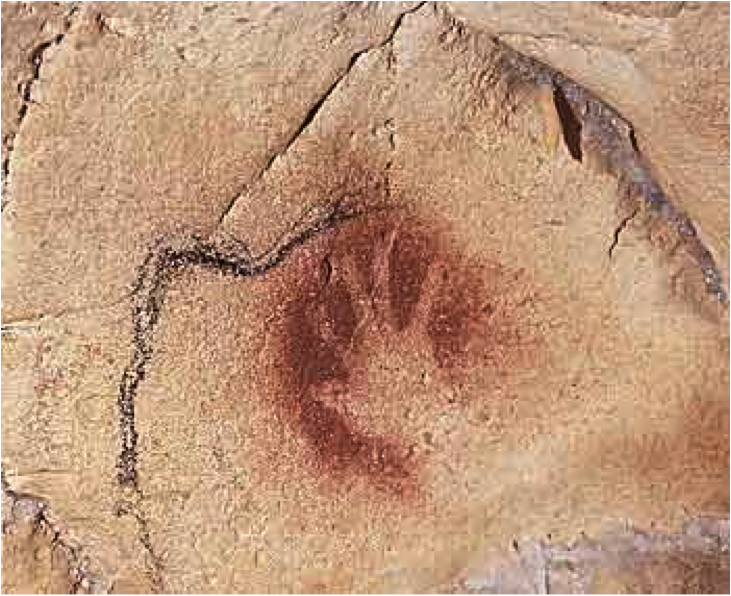 Grotte Chauvet. Jean-Marie Chauvet. © DRAC
The image above is a valid example of a complex conceptual system of expression that organizes time and altogether uses this organization to support itself. This image invents the abstraction of time i.e. the homogeneous dimension of succession, by clearly inscribing on Space a temporal object that would not exist without the system within which the inscription is being produced: this temporal object is the Now as the absolute partition generating the Past and the Future. What has existed before the imprint of the hand on the wall is radically different from what exists after this action. These two moments are kept apart by the spatial trace of the past action. Space is necessary to perform this conceptualization of Time as a passage from a before to a now and to an after, that Aristotle defines as an order of succession.(Aristotle 350 BCE, Book IV)
While this horizontal representation of spatialized Time is clearly perceivable through this image, another perception arises that holds together the moment of the creation of this image and the moment of its contemplation in a dimension that would be best qualified as vertical.
In this dimension, the various moments are not organized in an exclusive succession but are present all together in a vertiginous simultaneity. All the moments appear as nested the one within the other, the original action of the imprint instead of separating the before and the after joins them in a dimension that transcends the order of succession. In this dimension, the cause (imprinting) is explained and determined by the effect (the trace on the wall).